
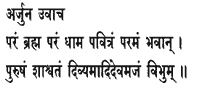
Arjuna said: Thou art the supreme Brahman, the supreme Abode, the supreme Purity, the one permanent, the divine Purusha, the original Godhead, the Unborn, the all-pervading Lord.
The Significance of Sacrifice
Sri Aurobindo
THE GITA’S theory of sacrifice is stated in two separate passages; one we find in the third chapter, another in the fourth; the first gives it in language which might, taken by itself, seem to be speaking only of the ceremonial sacrifice; the second interpreting that into the sense of a large philosophical symbolism, transforms at once its whole significance and raises it to a plane of high psychological and spiritual truth. “With sacrifice the Lord of creatures of old created creatures and said, By this shall you bring forth (fruits or offspring), let this be your milker of desires. Foster by this the gods and let the gods foster you; fostering each other, you shall attain to the supreme good. Fostered by sacrifice the gods shall give you desired enjoyments; who enjoys their given enjoyments and has not given to them, he is a thief. The good who eat what is left from the sacrifice, are released from all sin; but evil are they and enjoy sin who cook (the food) for their own sake. From food creatures come into being, from rain is the birth of food, from sacrifice comes into being the rain, sacrifice is born of work; work know to be born of Brahman, Brahman is born of the Immutable; therefore is the all-pervading Brahman established in the sacrifice. He who follows not here the wheel thus set in movement, evil is his being, sensual is his delight, in vain, O Partha, that man lives.” Having thus stated the necessity of sacrifice,—we shall see hereafter in what sense we may understand a passage which seems at first sight to convey only a traditional theory of ritualism and the necessity of the ceremonial offering,—Krishna proceeds to state the superiority of the spiritual man to works. “But the man whose delight is in the Self and who is satisfied with the enjoyment of the Self and in the Self he is content, for him there exists no work that needs to be done. He has no object here to be gained by action done and none to be gained by action undone; he has no dependence on all these existences for any object to be gained.” Here then are the two ideals, Vedist and Vedantist, standing as if in all their sharp original separation and opposition, on one side the active ideal of acquiring enjoyments here and the highest good beyond by sacrifice and the mutual dependence of the human being and the divine powers and on the other, facing it, the austerer ideal of the liberated man who, independent in the Spirit, has nothing to do with enjoyment or works or the human or the divine worlds, but exists only in the peace of the supreme Self, joys only in the calm joy of the Brahman. The next verses create a ground for the reconciliation between the two extremes; the secret is not inaction as soon as one turns towards the higher truth, but desireless action both before and after it is reached. The liberated man has nothing to gain by action, but nothing also to gain by inaction, and it is not at all for any personal object that he has to make his choice. “Therefore without attachment perform ever the work that is to be done (done for the sake of the world, lokasan˙ graha, as is made clear immediately afterward); for by doing work without attachment man attains to the highest. For it was even by works that Janaka and the rest attained to perfection.” It is true that works and sacrifice are a means of arriving at the highest good, ´sreyah. param av¯apsyatha; but there are three kinds of works, that done without sacrifice for personal enjoyment which is entirely selfish and egoistic and misses the true law and aim and utility of life, mogham˙ pa¯rtha sa jı¯vati, that done with desire, but with sacrifice and the enjoyment only as a result of sacrifice and therefore to that extent consecrated and sanctified, and that done without desire or attachment of any kind. It is the last which brings the soul of man to the highest, param a¯pnoti pu¯ rus.ah. . The whole sense and drift of this teaching turns upon the interpretation we are to give to the important words, yajn˜ a, karma, brahma, sacrifice, work, Brahman. If the sacrifice is simply the Vedic sacrifice, if the work from which it is born is the Vedic rule of works and if the brahman from which the work itself is born is the ´sabdabrahman in the sense only of the letter of the Veda, then all the positions of the Vedist dogma are conceded and there is nothing more. Ceremonial sacrifice is the right means of gaining children, wealth, enjoyment; by ceremonial sacrifice rain is brought down from heaven and the prosperity and continuity of the race assured; life is a continual transaction between the gods and men in which man offers ceremonial gifts to the gods from the gifts they have bestowed on him and in return is enriched, protected, fostered. Therefore all human works have to be accompanied and turned into a sacrament by ceremonial sacrifice and ritualistic worship; work not so dedicated is accursed, enjoyment without previous ceremonial sacrifice and ritual consecration is a sin. Even salvation, even the highest good is to be gained by ceremonial sacrifice. It must never be abandoned. Even the seeker of liberation has to continue to do ceremonial sacrifice, although without attachment; it is by ceremonial sacrifice and ritualistic works done without attachment that men of the type of Janaka attained to spiritual perfection and liberation. Obviously, this cannot be the meaning of the Gita, for it would be in contradiction with all the rest of the book. Even in the passage itself, without the illumining interpretation afterwards given to it in the fourth chapter, we have already an indication of a wider sense where it is said that sacrifice is born from work, work from brahman, brahman from the Akshara, and therefore the all-pervading Brahman, sarvagatam˙ brahma, is established in the sacrifice. The connecting logic of the “therefore” and the repetition of the word brahma are significant; for it shows clearly that the brahman from which all work is born has to be understood with an eye not so much to the current Vedic teaching in which it means the Veda as to a symbolical sense in which the creativeWord is identical with the all-pervading Brahman, the Eternal, the one Self present in all existences, sarvabhu ¯ tes.u, and present in all the workings of existence. The Veda is the knowledge of the Divine, the Eternal,—“I am He who is to be known in all the books of the Knowledge,” vedai´s ca vedyah. , Krishna will say in a subsequent chapter; but it is the knowledge of him in the workings of Prakriti, in the workings of the three gun. as, first qualities or modes of Nature, traigun. yavis.ay¯a ved¯ah. . This Brahman or Divine in the workings of Nature is born, as we may say, out of the Akshara, the immutable Purusha, the Self who stands above all the modes or qualities or workings of Nature, nistraigun. ya. The Brahman is one but self-displayed in two aspects, the immutable Being and the creator and originator of works in the mutable becoming, a¯tman, sarvabhu¯ ta¯ni; it is the immobile omnipresent Soul of things and it is the spiritual principle of the mobile working of things, Purusha poised in himself and Purusha active in Prakriti; it is aks.ara and ks.ara. In both of these aspects the Divine Being, Purushottama, manifests himself in the universe; the immutable above all qualities is His poise of peace, self-possession, equality, samam˙ brahma; from that proceeds His manifestation in the qualities of Prakriti and their universal workings; from the Purusha in Prakriti, from this Brahman with qualities, proceed all the works1 of the universal energy, Karma, in man and in all existences; from that work proceeds the principle of sacrifice. Even the material interchange between gods and men proceeds upon this principle, as typified in the dependence of rain and its product food on this working and on them the physical birth of creatures. For all the working of Prakriti is in its true nature a sacrifice, yajn˜ a, with the Divine Being as the enjoyer of all energisms and works and sacrifice and the great Lord of all existences, bhokta¯ram˙ yajn˜ atapasa¯m˙ sarvaloka-mahe´svaram, and to know this Divine all-pervading and established in sacrifice, sarvagata ˙ m yaj ˜ ne pratis.t. hitam, is the true, the Vedic knowledge.
But he may be known in an inferior action through the devas, the gods, the powers of the divine Soul in Nature and in the eternal interaction of these powers and the soul of man, mutually giving and receiving, mutually helping, increasing, raising each other’s workings and satisfaction, a commerce in which man rises towards a growing fitness for the supreme good. He recognises that his life is a part of this divine action in Nature and not a thing separate and to be held and pursued for its own sake. He regards his enjoyments and the satisfaction of his desires as the fruit of sacrifice and the gift of the gods in their divine universal workings and he ceases to pursue them in the false and evil spirit of sinful egoistic selfishness as if they were a good to be seized from life by his own unaided strength without return and without thankfulness. As this spirit increases in him, he subordinates his desires, becomes satisfiedwith sacrifice as the law of life and works and is content with whatever remains over from the sacrifice, giving up all the rest freely as an offering in the great and beneficent interchange between his life and the worldlife. Whoever goes contrary to this law of action and pursues works and enjoyment for his own isolated personal self-interest, lives in vain; he misses the true meaning and aim and utility of living and the upward growth of the soul; he is not on the path which leads to the highest good. But the highest only comes when the sacrifice is no longer to the gods, but to the one allpervading Divine established in the sacrifice, of whom the gods are inferior forms and powers, and when he puts away the lower self that desires and enjoys and gives up his personal sense of being the worker to the true executrix of all works, Prakriti, and his personal sense of being the enjoyer to the Divine Purusha, the higher and universal Self who is the real enjoyer of the works of Prakriti. In that Self and not in any personal enjoyment he finds now his sole satisfaction, complete content, pure delight; he has nothing to gain by action or inaction, depends neither on gods nor men for anything, seeks no profit from any, for the self-delight is all-sufficient to him, but does works for the sake of the Divine only, as a pure sacrifice, without attachment or desire. Thus he gains equality and becomes free from the modes of Nature, nistraigun. ya; his soul takes its poise not in the insecurity of Prakriti, but in the peace of the immutable Brahman, even while his actions continue in the movement of Prakriti. Thus is sacrifice his way of attaining to the Highest. That this is the sense of the passage is made clear in what follows, by the affirmation of lokasan˙ graha as the object of works, of Prakriti as the sole doer of works and the divine Purusha as their equal upholder, to whom works have to be given up even in their doing,—this inner giving up of works and yet physical doing of them is the culmination of sacrifice, —and by the affirmation that the result of such active sacrifice with an equal and desireless mind is liberation from the bondage of works. “He who is satisfied with whatever gain comes to him and equal in failure and success, is not bound even when he acts. When a man liberated, free from attachment, acts for sacrifice, all his action is dissolved,” leaves, that is to say, no result of bondage or after-impression on his free, pure, perfect and equal soul. To these passages we shall have to return. They are followed by a perfectly explicit and detailed interpretation of the meaning of yajn˜ a in the language of the Gita which leaves no doubt at all about the symbolic use of the words and the psychological character of the sacrifice enjoined by this teaching. In the ancient Vedic system there was always a double sense physical and psychological, outward and symbolic, the exterior form of the sacrifice and the inner meaning of all its circumstances. But the secret symbolism of the ancient Vedic mystics, exact, curious, poetic, psychological, had been long forgotten by this time and it is now replaced by another, large, general and philosophical in the spirit of Vedanta and a later Yoga. The fire of sacrifice, agni, is no material flame, but brahm¯agni, the fire of the Brahman, or it is the Brahman-ward energy, inner Agni, priest of the sacrifice, into which the offering is poured; the fire is self-control or it is a purified sense-action or it is the vital energy in that discipline of the control of the vital being through the control of the breath which is common to Rajayoga and Hathayoga, or it is the fire of self-knowledge, the flame of the supreme sacrifice. The food eaten as the leavings of the sacrifice is, it is explained, the nectar of immortality, amr.ta, left over from the offering; and here we have still something of the old Vedic symbolism in which the Soma-wine was the physical symbol of the amr.ta, the immortalising delight of the divine ecstasy won by the sacrifice, offered to the gods and drunk by men. The offering itself is whatever working of his energy, physical or psychological, is consecrated by him in action of body or action of mind to the gods or God, to the Self or to the universal powers, to one’s own higher Self or to the Self in mankind and in all existences. This elaborate explanation of the Yajna sets out with a vast and comprehensive definition in which it is declared that the act and energy and materials of the sacrifice, the giver and receiver of the sacrifice, the goal and object of the sacrifice are all the one Brahman. “Brahman is the giving, Brahman is the food-offering, by Brahman it is offered into the Brahman-fire, Brahman is that which is to be attained by samadhi in Brahmanaction.” This then is the knowledge in which the liberated man has to do works of sacrifice. It is the knowledge declared of old in the great Vedantic utterances, “I am He”, “All this verily is the Brahman, Brahman is this Self.” It is the knowledge of the entire unity; it is the One manifest as the doer and the deed and the object of works, knower and knowledge and the object of knowledge. The universal energy into which the action is poured is the Divine; the consecrated energy of the giving is the Divine; whatever is offered is only some form of the Divine; the giver of the offering is the Divine himself in man; the action, the work, the sacrifice is itself the Divine in movement, in activity; the goal to be reached by sacrifice is the Divine. For the man who has this knowledge and lives and acts in it, there can be no binding works, no personal and egoistically appropriated action; there is only the divine Purusha acting by the divine Prakriti in His own being, offering everything into the fire of His self-conscious cosmic energy, while the knowledge and the possession of His divine existence and consciousness by the soul unified with Him is the goal of all this God-directed movement and activity. To know that and to live and act in this unifying consciousness is to be free. But all even of the Yogins have not attained to this knowledge. “Some Yogins follow after the sacrifice which is of the gods; others offer the sacrifice by the sacrifice itself into the Brahman-fire.” The former conceive of the Divine in various forms and powers and seek him by various means, ordinances, dharmas, laws or, as we might say, settled rites of action, selfdiscipline, consecrated works; for the latter, those who already know, the simple fact of sacrifice, of offering whatever work to the Divine itself, of casting all their activities into the unified divine consciousness and energy, is their one means, their one dharma. The means of sacrifice are various; the offerings are of many kinds. There is the psychological sacrifice of self-control and self-discipline which leads to the higher self-possession and self-knowledge. “Some offer their senses into the fires of control, others offer the objects of sense into the fires of sense, and others offer all the actions of the sense and all the actions of the vital force into the fire of the Yoga of self-control kindled by knowledge.” There is, that is to say, the discipline which receives the objects of sense-perception without allowing the mind to be disturbed or affected by its sense-activities, the senses themselves becoming pure fires of sacrifice; there is the discipline which stills the senses so that the soul in its purity may appear from behind the veil of mind-action, calm and still; there is the discipline by which, when the self is known, all the actions of the senseperceptions and all the action of the vital being are received into that one still and tranquil soul. The offering of the striver after perfection may be material and physical, dravya-yajn˜ a, like that consecrated in worship by the devotee to his deity, or it may be the austerity of his self-discipline and energy of his soul directed to some high aim, tapo-yajn˜ a, or it may be some form of Yoga like the Pranayama of the Rajayogins and Hathayogins, or any other yoga-yajn˜ a. All these tend to the purification of the being; all sacrifice is a way towards the attainment of the highest. The one thing needful, the saving principle constant in all these variations, is to subordinate the lower activities, to diminish the control of desire and replace it by a superior energy, to abandon the purely egoistic enjoyment for that diviner delight which comes by sacrifice, by self-dedication, by self-mastery, by the giving up of one’s lower impulses to a greater and higher aim. “They who enjoy the nectar of immortality left over from the sacrifice attain to the eternal Brahman.” Sacrifice is the law of the world and nothing can be gained without it, neither mastery here, nor the possession of heavens beyond, nor the supreme possession of all; “this world is not for him who doeth not sacrifice, how then any other world?” Therefore all these and many other forms of sacrifice have been “extended in the mouth of the Brahman,” the mouth of that Fire which receives all offerings; they are all means and forms of the one great Existence in activity, means by which the action of the human being can be offered up to That of which his outward existence is a part and with which his inmost self is one. They are “all born of work”; all proceed from and are ordained by the one vast energy of the Divine which manifests itself in the universal karma and makes all the cosmic activity a progressive offering to the one Self and Lord and of which the last stage for the human being is self-knowledge and the possession of the divine or Brahmic consciousness. “So knowing thou shalt become free.” But there are gradations in the range of these various forms of sacrifice, the physical offering the lowest, the sacrifice of knowledge the highest. Knowledge is that in which all this action culminates, not any lower knowledge, but the highest, selfknowledge and God-knowledge, that which we can learn from those who know the true principles of existence, that by possessing which we shall not fall again into the bewilderment of the mind’s ignorance and into its bondage to mere sense-knowledge and to the inferior activity of the desires and passions. The knowledge in which all culminates is that by which “thou shalt see all existences (becomings, bhu¯ ta¯ni) without exception in the Self, then in Me.” For the Self is that one, immutable, all-pervading, all-containing, self-existent reality or Brahman hidden behind our mental being into which our consciousness widens out when it is liberated from the ego; we come to see all beings as becomings, bhu¯ ta¯ni, within that one self-existence. But this Self or immutable Brahman we see too to be the self-presentation to our essential psychological consciousness of a supreme Being who is the source of our existence and of whom all that is mutable or immutable is the manifestation. He is God, the Divine, the Purushottama. To Him we offer everything as a sacrifice; into His hands we give up our actions; in His existence we live and move; unified with Him in our nature and with all existence in Him, we become one soul and one power of being with Him and with all beings; with His supreme reality we identify and unite our self-being. By works done for sacrifice, eliminating desire, we arrive at knowledge and at the soul’s possession of itself; by works done in self-knowledge and Godknowledge we are liberated into the unity, peace and joy of the divine existence.
Sri Aurobindo
 About Us | ©1999 - 2009 searchforlight.org
All extracts and quotations from the written works of Sri Aurobindo and the Mother and the Photographs of
the Mother and Sri Aurobindo are copyright Sri Aurobindo Ashram Trust, Pondicherry -605002 India.